What Ships With Every Wear Plate Order ?
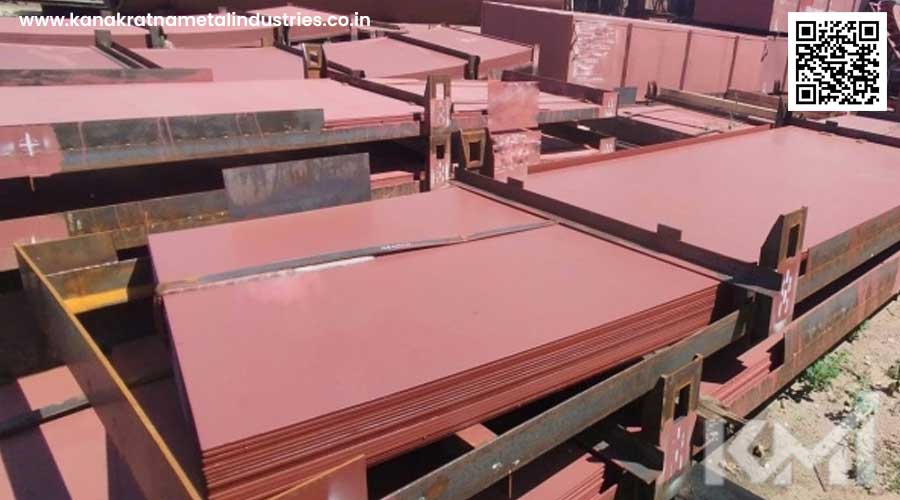
Six factors that keep quarry buyers coming back. As an established AR 400 Plate Stockist in India, we keep hardness-tested plates on the rack, not on indent.
Brinell-Verified Plate
Hardness Reading On Every Heat
Each plate carries a recorded Brinell value before it is released from our yard.
Nationwide Movement
2-5 Working Day Loading
Trailers leave for every Indian state straight off our Vadodara racks.
Stockholder Rates
One Layer, Not Three
Your rate comes off our inventory book without a trading commission stacked on top.
Live Wear-Plate Stock
Thin Gauge To Heavy Plate
Ready hardness-class plate on the floor, so no mill rolling slot is needed.
Profile Cutting In-House
Liners And Blanks To Drawing
Plasma and oxy-fuel profiling to your DXF, with edge condition agreed up front.
Complete Export Paperwork
Documents Before Loading
Packing list, invoice and origin papers travel with the consignment, not after it.
Quick answer: AR 400 Plate is a quenched and tempered wear-resistant steel with 360-440 HBW hardness, ~1100 MPa yield strength, and 1250-1300 MPa tensile strength. Ideal for wear liners, not structural or pressure applications.
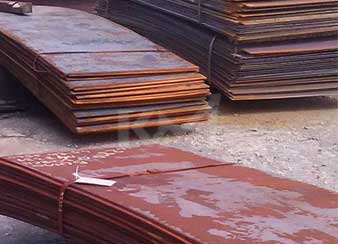
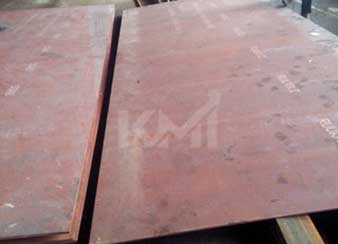
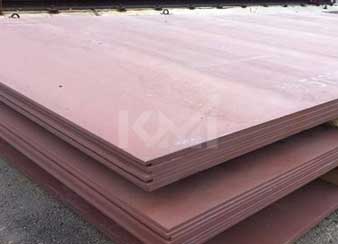
Kanak Ratna Metal Industries holds AR 400 Plate as live floor stock. Each plate is profiled and dispatched against recorded Brinell hardness readings. Mining contractors receive plates with hardness certificates matching trailer documentation. Crusher builders and tipper fabricators receive ready-to-use, certified AR 400 plates. Thickness ranges from 3mm sheet gauge to 100mm heavy plate. Plates are cut precisely according to your liner drawing requirements. Most consignments leave our Vadodara yard within two to five working days. Buyers across India rely on us as a dependable AR 400 Plate Stockist in Vadodara. Our stock is genuine, available, and backed by complete paperwork.
AR 400 is a hardness class, rather than a chemistry standard. Two mills can certify 400 HBW using different alloy recipes. Carbon equivalents can also vary between mills and plate thicknesses. This matters when fabricators determine preheat or bending radius requirements. We disclose the mill route used for every supplied plate. Actual ladle analysis is provided with the relevant carbon equivalent. Surface finishes include as-rolled, shot blasted, or shop primed options. Every release includes an EN 10204 certificate linked to heat numbers.
AR 400 Plate Specification
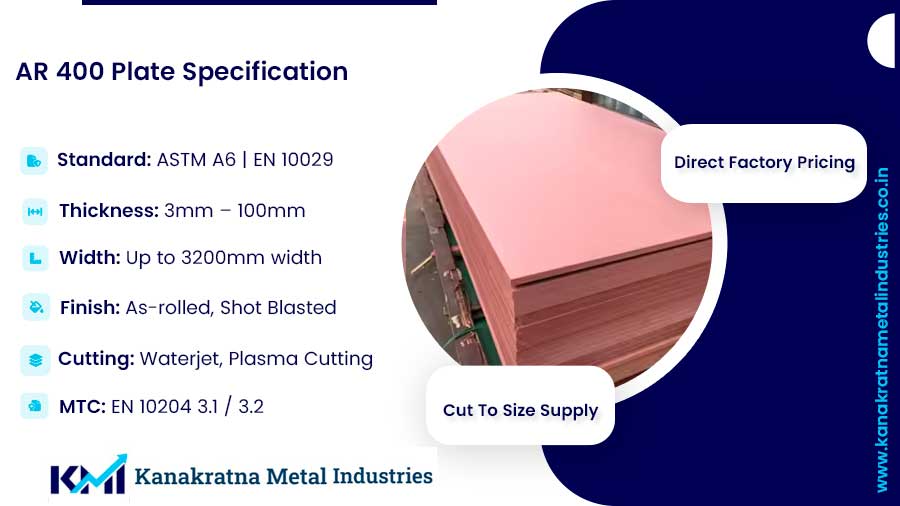
Here are the key verification points behind every AR400 Abrasion Resistant Steel Plate release.
AR 400 Steel Plate Thickness
- Available from 3mm sheet gauge to 100mm plate
- Thickness availability depends on mill and grade route
400 BHN Plate Reference Standard
- GB/T 24186 NM400 used as the written benchmark
- Mill brand datasheet governs where a brand is ordered
NM400 Steel Plate Hardness
- Brinell HBW to EN ISO 6506-1
- Read on a milled surface below the mill scale
Hardened 400 Plate Impact Toughness
- Charpy V typically 30-45 J at -40°C, longitudinal
- Indicative only unless written onto the order
Wear Resistant 400 Plates Dimensional Tolerance
- EN 10029 on European-route plate
- ASTM A6 half-standard flatness on US-route plate
HB 400 Steel Plates Surface Conditions
- As-rolled, shot blasted or shop primed
- Surface quality to EN 10163-2 Class A
Explore detailed HB 400 Wear Resistant Steel Plates chemistry, hardness, and testing data below.
Distinct Types of AR400 Plate
As a trusted AR 400 Plate Supplier In India, we offer ready-stock plates in the thickness, finish, and format your application demands.
AR 400 Steel Plate
- Standard quenched and tempered plate
- Highest-volume form on our racks
400 BHN Plate
- Specified purely by Brinell number
- Supplied with a recorded hardness reading
AR400 Abrasion Resistant Steel Plate
- Sliding and gouging wear duty
- Ordered against a Brinell acceptance band
NM400 Wear Resistant Plate
- Chinese mill route to GB/T 24186
- Budget option on repeat liner work
HB 400 Wear Resistant Plate
- Same class, European naming convention
- Common on EPC and consultant drawings
AR400F Plate
- Formable route for pressed liners
- Bends tighter without edge cracking
AR 400 Wear Plate Shipped Into African Mining Belts
Platinum, gold, copper and aggregate operations across these markets draw liner plate from us on repeat schedules.

Johannesburg, South Africa
Rustenburg, South Africa

Nairobi, Kenya
Mombasa, Kenya

Kampala, Uganda

Kitwe, Zambia

Dar es Salaam, Tanzania

Accra, Ghana
Need a 400 Wear Plate Price Today?
Share the required thickness, dimensions and quantity and we'll provide the latest ex-stock quote.
Chemical Composition of HB 400 Steel Plates
AR400 has no fixed chemistry, values vary by mill and grade route.
| Element | Symbol | Typical Max Ladle Analysis (%) |
|---|
| Carbon | C | 0.16 - 0.25 |
| Silicon | Si | 0.60 - 0.80 |
| Manganese | Mn | 1.40 - 1.70 |
| Phosphorus | P | 0.025 |
| Sulfur | S | 0.010 - 0.015 |
| Chromium | Cr | 0.50 - 1.50 |
| Nickel | Ni | 0.10 - 1.00 |
| Molybdenum | Mo | 0.25 - 0.50 |
| Boron | B | 0.005 |
NM400 Wear Resistant Plate Mechanical Properties
Wear plate is specified by hardness, with tensile values typically published as indicative figures.
360-440HBW, Nominal 400
Brinell Hardness
~1100MPa Typical
Yield Strength
1250-1300MPa Typical
Tensile Strength
30-45J At -40°C
Charpy V Impact
Q+TThrough-Hardened
Delivery Condition
HB 400 Abrasion Resistant Steel Plates Welding Guide
Carbon equivalent rises with thickness, increasing preheat requirements. Use your certificate's actual CEV and CET values.
6mm - 20mm Gauge
- CEV around 0.44, CET around 0.30
- Lowest preheat demand of the range
20mm - 32mm Gauge
- CEV around 0.53, CET around 0.35
- Preheat becomes routine, not optional
Above 32mm Gauge
- CEV around 0.57, CET around 0.35
- Highest restraint and cracking risk
Consumable Choice
- Low-hydrogen consumables throughout
- Soft filler on liner-to-frame joints
Interpass Control
- Cap interpass to protect the parent hardness
- Heat input drives the softened band width
No Post-Weld Heat Treatment
- PWHT destroys the quenched hardness
- Never re-heat treat AR400 after welding
Welding softens the HAZ, keep welds away from wear faces. Follow a qualified WPS for preheat.
Shipping AR 400 Plate Across Jebel Ali, UAE?
As a trusted AR 400 Plate Exporter, we manage export packing and documentation in-house.
Cold Bending Considerations For HB 400 High Strength Steel Plates
400 HBW wear plate requires generous radii and correct orientation for 90° bends up to 20mm.
Transverse BendMinimum inner radius around 3 × plate thickness
Longitudinal BendMinimum inner radius around 4 × plate thickness
Bend Line DirectionCross the rolling direction wherever the blank allows
Edge PreparationGrind the cut edge smooth before pressing
Formable RouteOrder AR400F where the radius has to tighten
Shop TemperatureAvoid pressing cold plate in an unheated bay
Dress cut edges, maintain punch clearance, and bend across the rolling direction.
Cutting & Drilling of Hardened 400 Plate
Thermal cutting creates a hardened rim and softened HAZ, process choice controls their extent.
Oxy-Fuel Cutting
- Workhorse for heavy gauge liner blanks
- Widest heat-affected zone of the three
Plasma Profiling
- Faster with a tighter affected zone
- Our standard route for profiled wear parts
Waterjet Cutting
- No thermal damage to the cut edge
- Best where hardness must survive to the edge
Drilling At 400 HBW
- Carbide tooling, slow speed, firm feed
- Rigid setup or the drill point will chip
Hole Placement
- Keep holes clear of the plate edge
- Ream or grind away the hardened rim
Avoid Cold Shearing
- Guillotining risks edge cracks at this hardness
- Profile-cut instead on anything structural
Send your DXF and we'll cut finished liners and blanks, keeping offcuts here.
AR400 Vs AR450 Comparison
The key comparison buyers make before ordering liners, both are hardness classes with typical distributor ranges.
AR400
Hardness Band360-440 HBW
Nominal Hardness400 HBW
Impact ToleranceHigher
FormabilityBetter
Weld DifficultyLower
Best DutySliding wear with impact
Relative CostLower
AR450
Hardness Band430-480 HBW
Nominal Hardness450 HBW
Impact ToleranceModerate
FormabilityReduced
Weld DifficultyHigher
Best DutyHarder, more abrasive feed
Relative CostHigher
Choose AR400 for formed, welded, or impact-loaded liners; use AR450 for highly abrasive, flat liners.
Unsure About Your 400 BHN Plate Hardness?
Share the required hardness and thickness and we'll help you select the right plate.
Service Temperature Limits of NM400 Wear Resistant Plate
Two questions decide whether 400 HBW is the right call: how hard the material being handled is, and how hot the liner gets in service.
250°C Service Ceiling
- Quenched properties are lost above this point
- Softening is permanent, not temporary
Cold Climate Duty
- Impact energy retained down to -40°C
- Suits Canadian and highland winter operation
Where 400 HBW Wins
- Sliding wear with regular heavy impact
- Coal, aggregate, sand and soft ore duty
When To Step Up
- Hard rock and high-silica abrasives
- Move to 450 or 500 HBW instead
Not A Structural Grade
- Wear liner duty only, never load-bearing
- Excluded from lifting and pressure parts
Cost Per Tonne Handled
- Judge on downtime, not on rate per kilo
- Thicker liner often beats harder liner
Thickness Chart of AR 400 Steel Plate
In-Stock size range for AR400 Plate - custom cutting on request.
| Thickness |
Width |
Length |
Weight(lbs/sqft) |
| 1/2" |
48.00" |
120.00" |
20.421 |
| 3/16" |
48.00" |
120.00" |
7.659 |
| 1/4" |
48.00" |
120.00" |
10.210 |
| 3/8" |
48.00" |
120.00" |
15.320 |
| 1/4" |
60.00" |
120.00" |
10.210 |
| 1/2" |
48.00" |
96.00" |
20.421 |
Hardness Rating of HB 400 Wear Resistant Plate
The number in the name is the nominal Brinell hardness. Here is what that means in practice on an AR 400 Wear Plate certificate.
360HBW Floor
Lower Acceptance Limit
400HBW Target
Nominal Rating
440HBW Ceiling
Upper Acceptance Limit
Where AR400 sits on the wider abrasion resistant ladder:
AR200 — Around 200 HBW
AR400 — 360-440 HBW
AR450 — 430-480 HBW
AR500 — 460-544 HBW
AR600 — 570-625 HBW
Read Below The Mill Scale
Through-Hardened, Not Case-Hardened
Mid-Thickness Reading On Request
Surface hardness may drop through heavy plate thickness, request through-thickness testing for 400 Wear Plate before ordering.
Testing Methods of 400 BHN Plate
As a reliable AR 400 Plate Supplier in Vadodara, We provide mill-certified material with complete traceability and documentation.
1
Brinell Hardness Testing
2
Brinell Hardness Verification
3
Mill Test Certificate Review
4
Chemical Composition Analysis
5
Ultrasonic Testing
6
Charpy V-Notch Impact Testing
Testing requirements are confirmed against the ordered mill grade and certificate.
AR400F Plate Into the Gulf
Quarry, crusher and aggregate operators across the GCC take repeat liner loads through Gulf ports.

Dubai & Jebel Ali, UAE
Fujairah, UAE

Dammam, Saudi Arabia

Sohar, Oman

Doha, Qatar

Istanbul, Turkey
Order AR400F Plate Built For Dump Truck Liners And Crusher Wear Plates
Applications of NM400 Steel Plate
Commonly applied in mining, quarrying, crushers, conveyors, hoppers, and wear liners.
Dump Truck Liners
Crusher Wear Plates
Excavator Bucket Liners
Transfer Chute Liners
Hoppers & Feed Bins
Conveyor Skirt Plates
Shredder Housings
Cement Mill Liners
Dozer Blades & Cutting Edges
Slurry Pipe Wear Sections
Screw Conveyor Flights
Refuse Truck Floors
Manufacturing AR 400 Plate Since 2022
EN 10204 3.1 / 3.2
Brinell Reading Per Heat
Looking for the Right AR 400 Steel Plate?
Send us your required thickness, dimensions and quantity and we'll confirm availability and pricing.
Frequently Asked Questions
What is the AR400 Plate steel equivalent?
Common equivalents include Hardox 400, Raex 400, Quard 400 and NM400. Compare datasheets.
What are the available AR 400 Steel Plate dimensions?
Thicknesses range from 3mm to 100mm, with widths up to 3200mm and lengths up to 12000mm.
What is the main difference between AR400F Plate and AR500 steel plates?
AR400 is softer and easier to form, while AR500 offers higher abrasion resistance but is harder to weld and bend.
Does HB 400 Wear Resistant Plate have a defined chemical composition?
No. AR400 is a hardness class, so chemistry varies by mill and grade route.
Can AR400 Abrasion Resistant Steel Plate be used structurally?
No. It is intended primarily for wear liners, not structural or pressure-retaining applications.
Is NM400 Wear Resistant Plate the same as AR400?
They share a similar hardness class, but NM400 is defined under GB/T 24186.
What is the maximum service temperature for HB 400 Abrasion Resistant Steel Plates?
Around 250°C, higher temperatures can permanently reduce its hardness.


 SSAB
 SSAB Europe
 NLMK Clabecq
 GB/T 24186
 Dillinger
 JFE Steel
 voestalpine
 Tata Steel
 Bisalloy